The Best Manhattan Associates Alternatives
- Blue Yonder for supply chain planning and execution on one platform
- SAP EWM for SAP-centric IT organizations
- Infios for a highly integrated WCS solution
- Hardis WMS for modularity, autonomy, and a long-term partnership
Who Is Manhattan Associates
Manhattan Active is the company’s cloud-native, microservices-based platform. One suite covering warehouse execution, transportation, and order management through Manhattan Active Omni.
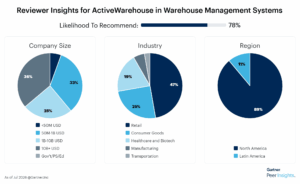
The profile it serves best: large enterprise retail first, then manufacturing and CPG — organizations with mature IT teams and global operations. Its own reviewer base on Gartner Peer Insights says the same: 47% retail, 89% North America, 78% willing to recommend.
We cross paths with Manhattan in RFPs all the time.
Sometimes they win. Sometimes we do.
So consider this article a view from inside those deals: who the leader fits, and what to weigh if that profile isn’t quite yours.
The Best Manhattan Associates Alternatives at a Glance
| WMS | Willing to recommend | Capability Score | Evaluation & Contracting | Integration & Deployment | Service & Support |
| Manhattan | 78% | 4,5/5 | 4,1/5 | 4,0/5 | 3,9/5 |
| Hardis WMS | 81% | 4,5/5 | 4,2/5 | 4,3/5 | 4,2/5 |
| SAP EWM | 73% | 4,4/5 | 4,2/5 | 4,2/5 | 4,1/5 |
| Infios WMS | 81% | 4,5/5 | 4,3/5 | 4,4/5 | 4,2/5 |
| Blue Yonder | 98% | 4,8/5 | 4,6/5 | 4,7/5 | 4,6/5 |
*Gartner Peer Insights reviews, July 2026.
Blue Yonder: best Manhattan alternative for supply chain planning and execution on one platform
If Manhattan is on your shortlist, Blue Yonder should be too.
The other longtime Magic Quadrant leader is strongest where planning meets execution: supply chain planning and AI/ML forecasting feeding warehouse operations on a single platform. Its natural profile is the global retail or manufacturing group managing a complex, multi-site network.
Nobody in your steering committee will question the maturity of this choice.
SAP EWM: best Manhattan alternative for SAP-centric IT organizations
SAP Extended Warehouse Management is the ERP-first option.
If your IT strategy is built around SAP, EWM keeps warehouse management inside that ecosystem, with native integration and a single data model. That logic suits manufacturing and distribution companies already deep in SAP — though pairing a best-of-breed WMS with an SAP core is a common choice there too, when warehouse depth matters more than single-vendor governance.
Infios: best Manhattan alternative for a highly integrated WCS solution
Infios (formerly Körber Supply Chain Software) is the option for automation-heavy sites.
Its strength is the tight coupling between warehouse management and warehouse control — the WCS layer that orchestrates conveyors, sorters, AS/RS and AMRs on the floor. For operations built around mechanization, getting execution and control from a single vendor removes a layer of integration risk, and it’s why Infios fits sites where the automation is as much the project as the software.
Hardis WMS: best Manhattan alternative for modularity, autonomy, and a long-term partnership
Hardis WMS is our platform, so read this card knowing that. By revenue, we’re among the top 6 WMS vendors worldwide and we held this card to the same standard as the other three.
Hardis Supply Chain is a subsidiary of Hardis Group (1,700 employees), staffed mostly by logisticians, and launched its WMS in 1994. Forty years of continuous investment later, the platform runs more than 2,000 warehouses for 470+ customers worldwide, from mid-market companies to international groups — Pandora their reasons, in their own words and Renault among them.
Recognized by global analysts: Nucleus Research Value Matrix (global), Gartner WMS study (Europe), Gartner Market Guide for OMS (global, covering our execution + order management suite).
Billing by concurrent connection, right-sized pilots, autonomy by design, and a strong footprint in 3PL warehousing.
Reasons to Consider Alternatives to Manhattan
Here’s the mots interesting part of this piece of content.
Actually, you don’t have to take our word for why buyers look past the leader.
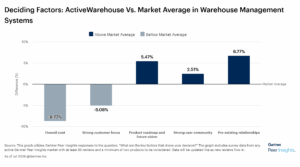
Gartner asked reviewers what drove their decision.
Manhattan scores “below the market average” on exactly two things: overall cost (-8.77%) and strong customer focus (-5.08%). It scores “above” on pre-existing relationships (+6.77%) and product roadmap (+5.47%).
Read that again.
People choose the leader for its roadmap, and because they already work with it — not for its cost, and not for how closely it works with them.
Which is exactly where the real decision lives:
- How you’re billed
- What a custom development costs
- How the project is sized, and who holds the keys after go-live.
4 criteria that compound over ten years, across the entire suite — execution, order management, planning.
Pricing model in multi-shift operations
Warehouses run on shifts. Morning team, evening team. Add a wave of temporary workers at peak season.
A pricing model based on named users can’t follow that reality. Every operator who touches the system carries a usage right whether they work full weeks or two weekends in December.
We won’t detail any vendor’s pricing grid here. Third-party estimates like ITQlick are public if you want them.
What we can say: a named-user model gives you no way to optimize costs when your teams rotate.
The alternative practice on the market is billing by concurrent connection. A morning team and an evening team sharing the same 100 terminals consume 100 usage rights, not 200.
Over ten years of SaaS cloud WMS pricing, that structural difference becomes a different TCO.
Want to see it on your own volumes? Our WMS ROI calculator models exactly that.
The cost of custom developments
You will customize.
Everyone plans to stick to the standard. Then reality shows up: a client-specific flow, a mechanization constraint, a process no other warehouse runs.
What matters is the bill each customization drags behind it when you build it, then at every upgrade for as long as you run the system.
Microservices architectures are modern, and they update continuously. But when a standard service doesn’t fit your process, customizing can mean replacing an entire service with a specific one, developed and maintained outside the platform.
Users say it in their own words on Reddit: “need IT team”, “expensive”, “you need to be familiar with the API to get the data out”.
Our position after four decades of these projects: a customization is worth building if and only if it’s a genuine business differentiator. Everything else turns into logistical debt — workarounds and specifics your teams will carry for years.
So before you sign, ask for a real number: what will one specific development cost in year 3, once it has to be maintained and retested at every upgrade?
Time-to-pilot
A project with the leader takes time. Rich platform, dense configuration, heavy integration — everyone in this market knows it and plans for it.
How much budget will you have committed before the first tangible result?
One approach our large accounts appreciate is the right-sized pilot.
6 months. 1 flow. 1 site.
Not every project needs one. When it fits, it lets you check the platform against your own logistics processes in real conditions — and decide on the full deployment with numbers instead of projections.
Renault started this way, with a pilot on a small, agile flow before scaling.
And there’s a side benefit that rarely makes it into RFP scoring: the teams who run the pilot are the same ones who carry the change afterwards. By go-live, the system is already theirs.
Autonomy and the vendor relationship
A reality of working with a very large software vendor is that the roadmap is theirs.
Influencing it, or co-innovating on it, is a privilege reserved for a handful of ultra-strategic global clients. Everyone else absorbs the vendor’s decisions — commercial model, contract revisions, end-of-life announcements. That “strong customer focus” score, below market average, is what this looks like once you’re a client.
The alternative practice is autonomy by design.
A platform built so your IT and business teams take ownership and build competence internally, instead of opening a vendor ticket for every change.
Partnership, meanwhile, can be verified.
We piloted the Scandit solution with LVMH on Dior’s warehouses (press release). Pandora explained publicly why it chose us: a partner, flexibility, personalization.
FAQ
What should you look for in a Manhattan alternative?
Functional coverage is a given at this level of the market, so look at the model: the pricing structure and how it handles shifts, the cost of custom developments over time, the size of the first project phase, and the autonomy your teams keep after go-live.
Is it possible to switch from Manhattan WMS?
Yes — large accounts have done it, and moves happen in both directions. In our experience, a switch is driven by the financial model and the vendor relationship rather than by features. A right-sized pilot on one flow is the safest way to test the move before committing.
How can you choose the right Manhattan alternative?
Start from your profile. SAP-centric IT organizations will shortlist SAP EWM, or a best-of-breed WMS coupled with SAP. Retail and manufacturing groups that put planning first lean toward Blue Yonder. Automation-heavy sites that want warehouse management and control from one vendor look at Infios. Operations that want modularity, autonomy, and a close partnership shortlist Hardis WMS.
Which Manhattan Associates alternative works best for 3PL operations?
3PLs need to start a site in three months, customize for their own clients, and keep control of their platform — needs the very large vendors serve poorly. Hardis WMS was built around that autonomy, which is why [3PL operations](/industries/3pl-warehouse-management-software/) are one of its strongest segments.
—
If you’re building the RFP now, help yourself to our WMS RFP framework. It’s structured around the 4 criteria above.